
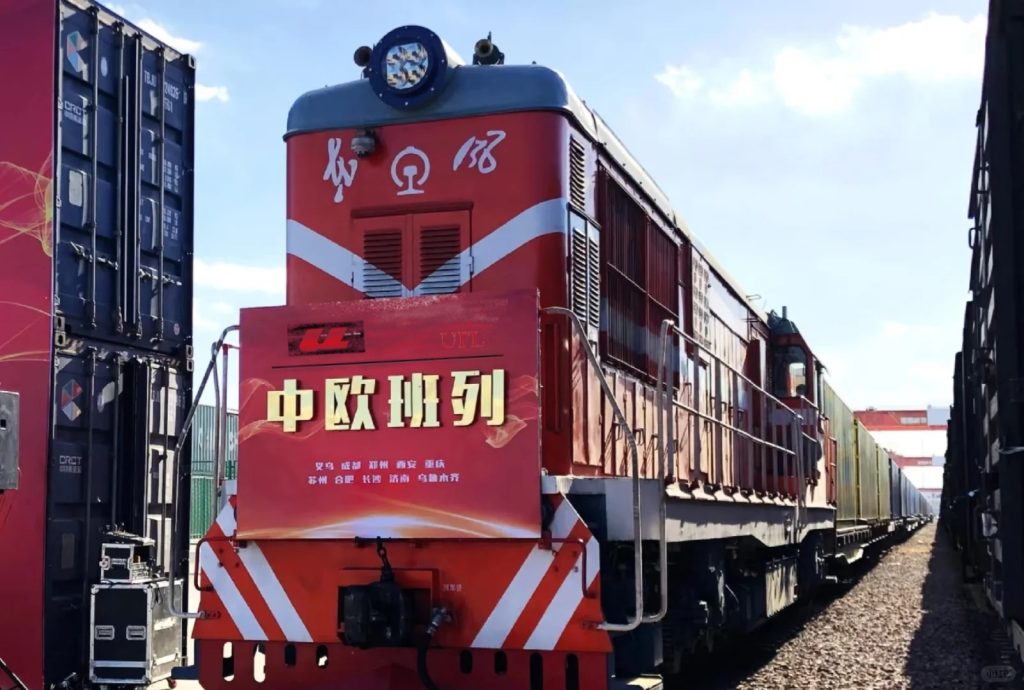
Global supply chains continue to face disruption caused by geopolitical tensions, changing maritime routes, port congestion and volatile fuel surcharges.
Many international shippers now face a difficult choice:
- Ocean freight offers the lowest cost but may take too long.
- Air freight is fast but can be expensive.
- China–Europe rail freight provides a middle option that balances cost, transit time and supply chain flexibility.
The China–Europe Railway Express connects major industrial cities in China with logistics hubs across Europe through the Eurasian rail corridor.
For businesses that need faster replenishment than ocean freight but do not require the speed or cost of air freight, rail transportation can be a practical solution.
U-Freight supports businesses with integrated international freight forwarding services covering rail, air, ocean, customs coordination, warehousing and European distribution.
Why Are Ocean and Air Freight Costs and Transit Times Becoming Less Predictable?
International freight performance can be affected by several factors:
- Maritime route changes;
- Geopolitical tensions;
- Fuel surcharge increases;
- Port congestion;
- Limited air cargo capacity;
- Seasonal demand;
- Customs clearance delays;
- Equipment and capacity shortages;
- Fragmented regional supply chains.
These factors can make traditional transport plans more difficult to manage.
Ocean freight remains suitable for large-volume and cost-sensitive cargo, while air freight is usually preferred for urgent or high-value shipments. Rail freight can provide another option for businesses that need a balance between cost and speed.
What Is China–Europe Rail Freight?
China–Europe rail freight is a cross-border railway service linking China with Europe through the Eurasian rail network.
It is commonly used for:
- Consumer electronics;
- Fashion and apparel;
- Automotive components;
- Industrial machinery;
- Medical equipment;
- E-commerce inventory;
- Retail replenishment goods;
- General commercial cargo.
Depending on the origin, destination, customs process and final delivery location, rail freight can provide a more predictable middle-distance transport option than some ocean routes.
Main China Departure Hubs
Common departure cities and rail hubs include:
- Zhengzhou;
- Changsha;
- Chengdu;
- Hefei;
- Chongqing;
- Xi’an;
- Wuhan.
The most suitable departure point depends on the cargo’s origin, factory location, available rail service, inland transportation requirements and final destination.
Main Border Gateways
Common China-Europe rail border gateways include:
- Alashankou;
- Khorgos.
The route, border crossing and operational arrangement may change according to service availability, customs requirements, seasonal conditions and network capacity.
Main European Entry Points
European rail freight may enter through locations such as:
- Brest;
- Małaszewicze.
From the rail entry point, cargo can continue by road or rail to regional distribution centres and final delivery locations.
U-Freight’s European Distribution Network
U-Freight can coordinate rail freight with European distribution and last-mile delivery through logistics hubs such as:
- Hamburg, Germany;
- Munich, Germany;
- Duisburg, Germany;
- Liège, Belgium;
- Warsaw, Poland.
From these locations, cargo can be distributed across Europe through road transportation and intermodal logistics networks.
Businesses should confirm the available route, estimated transit time, customs process and delivery arrangement for each shipment before booking.
Why Choose Rail Freight Instead of Ocean or Air?
Faster Than Most Ocean Freight Options
Rail freight can be faster than standard ocean freight, particularly when ocean routes are affected by congestion, rerouting or extended transit times.
More Cost-Effective Than Air Freight
Rail freight is generally less expensive than air freight for non-urgent cargo, although the actual cost depends on route, cargo type, weight, volume, seasonality and origin charges.
More Predictable Replenishment
For businesses managing seasonal products, retail stock or e-commerce inventory, rail can provide a useful balance between transportation cost and replenishment speed.
Lower Emissions Than Air Freight
Rail freight generally produces lower carbon emissions than air freight. The actual environmental impact depends on the route, mode combination, cargo weight, energy source and first- and last-mile transportation.
Less Reliance on Maritime Routes
Rail can help reduce a company’s dependence on ocean routes during periods of disruption. It should be viewed as part of a diversified transport strategy rather than a complete replacement for ocean freight.
China–Europe Rail Freight Compared with Ocean and Air Freight
| Factor | Rail Freight | Ocean Freight | 空運服務 |
|---|---|---|---|
| Typical transit time | Around 15–20 days | Around 30–60+ days | Around 3–7 days |
| Cost level | Medium | Lowest for large volumes | Highest |
| Suitable for | Balanced cost and speed | Bulk and non-urgent cargo | Urgent shipments |
| Schedule stability | Generally stable, subject to route and border conditions | Can be affected by port and maritime disruption | Fast but capacity and fuel costs may fluctuate |
| Carbon emissions | Generally lower than air | Generally lower than air | Highest among the three |
| Supply chain role | Replenishment and diversification | Cost control | Speed and urgency |
The figures above are general planning ranges, not guaranteed service levels. Transit time and price should be confirmed based on the actual route and cargo.
Is China–Europe Rail Freight Faster Than Ocean Freight?
In many cases, yes.
Rail freight may take around 15–20 days, while ocean freight can take 30–60 days or longer when routes are congested or rerouted.
The actual lead time depends on:
- Origin city;
- Rail departure schedule;
- Border processing;
- Customs clearance;
- European rail arrival point;
- Final delivery destination;
- Cargo type;
- Seasonal conditions.
Rail is often suitable for inventory replenishment and medium-speed supply chains.
Is Rail Freight Cheaper Than Air Freight?
Generally, yes.
Rail freight is usually more cost-effective than air freight for cargo that is not urgent. However, the final price depends on:
- Route;
- Cargo type;
- Gross weight;
- Volume;
- Chargeable weight;
- Seasonality;
- Origin station charges;
- Customs requirements;
- Final delivery location.
The most useful comparison is not simply the transport price. Businesses should also consider inventory holding costs, stockout risks, sales deadlines and the cost of delayed delivery.
Which Cargo Is Suitable for China–Europe Rail Freight?
Rail freight can be suitable for:
- Fashion and apparel;
- Consumer electronics;
- Automotive parts;
- Industrial equipment;
- Machinery;
- Medical equipment;
- Retail inventory;
- E-commerce stock;
- Spare parts;
- General commercial goods.
Cargo with strict temperature-control, dangerous goods or special handling requirements should be reviewed before booking.
How Reliable Is China–Europe Rail Freight?
Rail freight can provide a reliable alternative when businesses need to reduce their exposure to maritime disruption.
Potential advantages include:
- Structured rail schedules;
- Less exposure to ocean weather conditions;
- Reduced reliance on congested sea routes;
- Alternative routing options;
- Better control over replenishment planning.
However, rail freight can still be affected by border congestion, customs inspections, extreme weather, changes in railway capacity and geopolitical developments. It should not be presented as disruption-free.
When Should a Business Consider Rail Freight?
Rail freight may be worth considering when:
- Ocean freight is too slow for the required replenishment cycle;
- Air freight is too expensive for the product margin;
- Inventory turnover speed is important;
- The business wants to diversify transport modes;
- Supply chain resilience is a priority;
- The company has sustainability objectives;
- The cargo is not urgent enough to require air freight;
- The shipment is too time-sensitive for standard ocean freight.
A diversified supply chain may combine ocean freight for base stock, rail freight for planned replenishment and air freight for urgent shipments.
U-Freight’s China–Europe Rail Freight Support
U-Freight can coordinate the main stages of a rail freight shipment, including:
- Space booking and departure planning;
- Cargo collection;
- Export documentation;
- Customs documentation;
- Rail waybill coordination;
- Pre-arrival clearance preparation;
- European rail arrival coordination;
- Road and intermodal distribution;
- Final delivery;
- Shipment tracking;
- Proof of delivery;
- Container return management.
Space planning is recommended in advance, particularly during peak periods. The exact booking lead time depends on the route, cargo type, season and available capacity.
U-Freight’s global logistics network can combine rail, ocean, air, customs, warehousing and distribution according to the requirements of each supply chain.
FCL and LCL Rail Freight Loading Guidelines
Full Container Load (FCL)
A 40-foot high-cube container may provide approximately 68 cubic metres of capacity, with a typical weight limit of around 21 tonnes. Some routes may allow higher limits subject to operational and regulatory conditions.
Shippers should consider:
- Even weight distribution;
- Cargo securing;
- Packaging strength;
- Container suitability;
- Loading sequence;
- Route-specific weight restrictions;
- Customs and documentation requirements.
Less than Container Load (LCL)
LCL rail freight may be suitable for smaller shipments that do not require a full container.
General planning considerations may include:
- Package length below 2 metres;
- Shipment weight below 3 tonnes;
- Additional charges for oversized cargo;
- Minimum volume rules for non-stackable goods;
- Special handling fees;
- Consolidation and deconsolidation requirements.
These are general guidelines only. The applicable limitations depend on the route, rail operator, terminal and destination.
Documents Usually Required
A rail freight shipment may require:
- Commercial invoice;
- Packing list;
- Export declaration;
- Import documentation;
- Rail waybill;
- Product information;
- Customs authorisation;
- Certificates or licences where applicable.
The exact document set depends on the product, origin, destination, customs regime and trade terms.
Why Choose U-Freight?
U-Freight can support China–Europe rail freight through:
- Rail freight route coordination;
- Customs document handling;
- European distribution hubs;
- Real-time shipment visibility;
- Integrated rail, air and ocean solutions;
- Inventory replenishment planning;
- Last-mile delivery coordination;
- Supply chain contingency planning.
Businesses can also combine warehousing and distribution services with rail transportation to support European inventory positioning and regional order delivery.
Contact U-Freight About China–Europe Rail Freight
China–Europe rail freight is increasingly becoming an important part of supply chain planning. It can provide a practical balance between cost, speed and reliability when ocean freight is too slow and air freight is too expensive.
To evaluate a rail, air or ocean freight solution, contact U-Freight and provide:
- Cargo type;
- Number of packages;
- Gross weight;
- Volume;
- Origin city;
- Destination city;
- Required delivery date;
- Incoterms;
- Customs requirements;
- Whether the cargo requires FCL or LCL;
- Any special handling requirements.
常見問題
What is China–Europe rail freight?
China–Europe rail freight is a cross-border railway service connecting China and Europe through the Eurasian rail network. It provides a middle-distance option between ocean and air freight.
Is rail freight cheaper than air freight?
Usually, yes. Rail freight is generally more cost-effective for non-urgent cargo, but the final price depends on route, weight, volume, seasonality, origin charges, customs and final delivery.
How reliable is China–Europe rail freight?
Rail freight can provide structured schedules and reduce reliance on maritime routes. However, border congestion, customs inspections, weather and geopolitical conditions can still affect the shipment.
Is China–Europe rail freight still reliable in 2026?
It remains a useful transport option, but route capacity, border conditions, customs procedures and geopolitical developments should be checked before booking each shipment.
What documents are required?
Common documents include a commercial invoice, packing list, export and import documents, customs information and a rail waybill. The exact requirements depend on the cargo and route.
Can rail freight support ESG objectives?
Rail freight generally produces lower carbon emissions than air freight. Businesses should evaluate the full transport chain, including collection, terminal handling, final delivery and any road or air connections.
How long does China–Europe rail freight take?
A general planning range is around 15–20 days, but actual transit time depends on the origin, route, border processing, customs clearance and final delivery location.
Which cities are connected by China–Europe rail freight?
Common Chinese hubs include Zhengzhou, Chengdu, Xi’an, Chongqing, Hefei, Changsha and Wuhan. European destinations may include Hamburg, Duisburg, Munich, Liège and Warsaw, subject to available services.
What cargo is suitable for rail freight?
Electronics, fashion, automotive parts, machinery, medical equipment, retail products and e-commerce inventory may be suitable. Special cargo should be assessed before booking.
